📚 What if your name wasn’t just two words on an ID card, but a family tree spanning generations, a secret prayer spoken only in sacred ceremonies, or a legal record of both your parents’ heritage? Across the globe, cultures have found radically different ways to answer a simple question: Who are you? This cultural lecture looks at the structure and meaning behind some of the world’s most distinctive naming systems.
1. Family name first, or given name first?
The order of a name reflects how a society sees the relationship between the individual and the family.
- Family name first (East Asia and Hungary): In Chinese, Korean and Hungarian, the family name comes before the given name, reflecting the value that family lineage and collective identity come before the individual.
- Given name first (the Western world): Most Western naming systems place the given name before the family name, emphasising individuality and personal expression.
2. Europe: three different structures
Russia: given name + patronymic + surname
- Given name: Traditionally drawn from the Orthodox calendar of saints. A child born near a saint’s feast day is named after that saint, making their Name Day an annual celebration as important as a birthday.
- Patronymic: Formed from the father’s first name with a standard suffix. If the father is Nikolay, his son is Nikolayevich (“son of Nikolay”) and his daughter Nikolayeva (“daughter of Nikolay”). Since the 9th century, the patronymic has been an essential marker of formal respect.
- Surname: Often derived from trades, places or ancestry, such as Kovalev (blacksmith), Popov (priest), Rybakov (fisherman) or Melnikov (miller).
Spain: one given name, two surnames
- A full name is made up of a given name (simple, like Penélope, or composite, like José María), followed by the father’s first surname and the mother’s first surname. Penélope Cruz Sánchez, for example, inherits Cruz from her father and Sánchez from her mother.
- Women do not change their surnames when they marry; they keep both of their own surnames for life.
- Children take the first surname of each parent: if José García Torres and María Acosta Gómez have a daughter named Yolanda, her full name is Yolanda García Acosta.
- The surname ending -ez (as in Fernández, Rodríguez, Gómez) historically means “son of”; Fernández means “son of Fernando”.
- Portugal also uses two surnames, but traditionally in the opposite order: the mother’s surname first, then the father’s.
- Nicknames are common in daily life: José becomes Pepe or Chema, and María de las Mercedes becomes Merche.
Hungary: the Eastern name order in Europe
- Hungary is one of very few European countries that puts the family name first, as in Szabó János, where Szabó is the surname and János the given name.
- Parents cannot simply invent a given name: they must choose from an official, regularly updated list maintained under the Hungarian Academy of Sciences, and names not on the list require a formal request. Foreign names are adapted to Hungarian spelling, so Jennifer becomes Dzsenifer.
- Hungarians also have a strong tradition of celebrating Name Days.
For anyone learning Mandarin in Hungary, this is a familiar point: just like Hungarian, Chinese puts the family name first.
3. The Arabic name chain
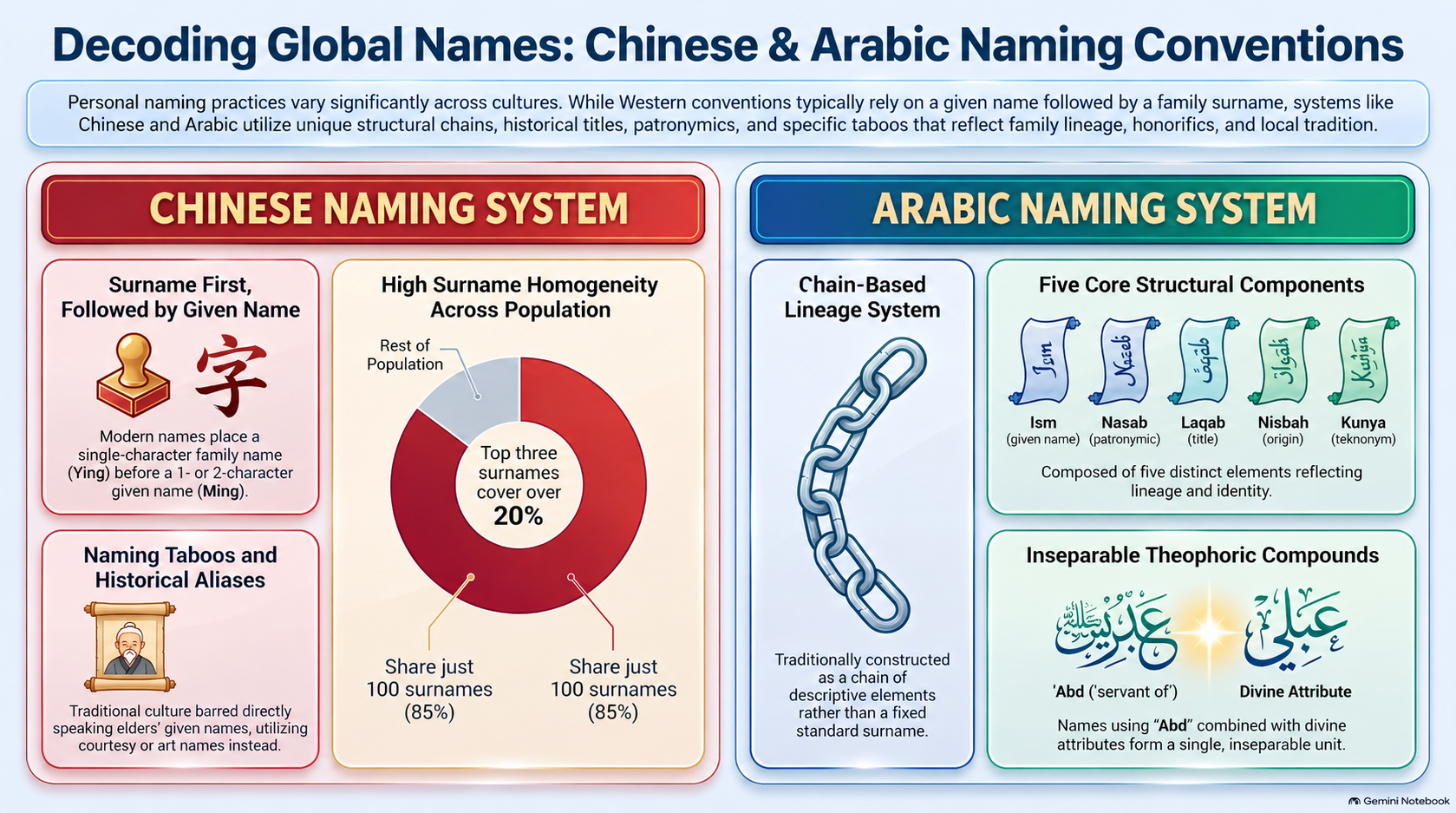
A traditional Arabic name is not just a two-word label but a genealogical chain that records a person’s heritage. A classical full name can contain up to five elements:
- Ism (given name): The personal name given at birth, such as Muhammad, Sami or Fatimah. Many express character or religious devotion, such as names beginning with ʿAbd (“servant of”): Abdullah (“servant of God”) or Abdulrahman (“servant of the Most Merciful”).
- Nasab (patronymic chain): Lineage linked with ibn or bin (“son of”) and bint (“daughter of”). Saleh ibn Tariq ibn Khalid literally means “Saleh, son of Tariq, son of Khalid”.
- Laqab (honorific or epithet): A title expressing admiration, status or character, such as al-Rashid (“the Rightly-Guided”) or names ending in al-Din (“of the Faith”), like Salah al-Din (Saladin).
- Nisbah (origin): Indicates ancestral origin, tribe, city or profession, usually ending in -i: al-Halabi means “from Aleppo”, al-Baghdadi “from Baghdad”, and al-Khayyat “the tailor”.
- Kunya (teknonym): A respectful title naming a parent after their firstborn child, using Abu (“father of”) or Umm (“mother of”). A father whose firstborn son is Yusuf is addressed as Abu Yusuf.
Arab women also keep their birth family name after marriage. Modern official documents often shorten names to three or four parts, but the underlying lineage structure remains.
Two common mistakes in Western paperwork
- Splitting compound names: Names like Abdul-Rahman or Habibullah are grammatical compounds. Abdul simply means “servant of the” and cannot stand alone. Addressing Abdul-Rahman bin Omar al-Ahmad as “Mr. Rahman” or “Mr. Abdul” is incorrect; he should be addressed as Abdul-Rahman, or formally as Mr. al-Ahmad.
- Treating Bin or Ben as a middle name or surname: In Sami Ben Ahmed, Ben is the connector “son of”. Calling him “Mr. Ben Ahmed” mistakes the connector for a family name.
4. East Asia: family first
Surname and given name
- A modern Chinese name usually places a single-character surname (姓 xìng) first, followed by a given name (名 míng) of one or two characters.
- Surnames are highly concentrated: the top three, Wang (王), Li (李) and Zhang (張), cover over 20% of China’s population. In Korea, five surnames (Kim, Lee, Park, Choi, Jung) account for roughly half the population.
- Over 80% of modern Chinese given names have two characters, chosen for sound, tonal balance and meaning. Many families use a generation name (字輩 zìbèi): all siblings and cousins of the same generation share one character, often set out generations in advance in a family generation poem.
One person, many names
Because of strict naming taboos, which forbade juniors and subjects from speaking the personal names of elders or emperors, educated people in traditional China used different names in different settings:
- Milk name (乳名 rǔmíng): An informal childhood name given after birth. In Taiwanese tradition, humble names such as 豬屎 (“pig droppings”) or 罔市 were sometimes used to keep children safe from bad luck.
- Courtesy name (字 zì): An adult name given at maturity, used by peers instead of the personal name as a sign of respect.
- Art name (號 hào): A self-chosen pen name used by scholars, poets and artists.
- Posthumous and temple names: Honorific titles given after death to rulers and distinguished statesmen.
Today, some parents also choose names inspired by events of the time (such as 奧運, “Olympics”) or consult fortune-tellers about the five elements and stroke counts.
Writing Chinese names in the Latin alphabet
- Mainland China: Uses Hanyu Pinyin (adopted in 1958). Surname and given name are written separately, and a two-character given name is written as one word without a hyphen, e.g. Wang Xiuying.
- Taiwan and Hong Kong: Often use older systems such as Wade-Giles or Cantonese romanisation, frequently hyphenating the two characters of the given name, e.g. Kuo Chi-yung.
- International style guides: Editorial rules such as those of the Food and Agriculture Organization (FAO) require Chinese names in Pinyin to separate surname and given name, capitalise the first letter of each, write two-character given names as one word with the second syllable in lower case, and omit tone marks. When foreign names are translated into Chinese, authoritative name dictionaries should be followed, and names from non-Latin scripts such as Japanese or Korean should be rendered from the original language rather than from their English spelling.
- Same spelling, different characters: Identical romanisations can come from completely different characters and meanings; Wang, for example, can be 王 or 汪.
5. Sacred names and destiny: Navajo and West African traditions
The Navajo (Diné): a private name and four clans
- Sacred ceremonial name: Given to a child by an elder during a sacred ceremony, this name connects the person to spiritual forces. It is kept private within the close family and spoken only in ceremonial contexts.
- The four-clan system: When introducing themselves, Diné people name the clan they are born to (the mother’s clan), the clan they are born for (the father’s clan), their maternal grandfather’s clan and their paternal grandfather’s clan.
- Because lineage passes through the mother, women hold a central role in preserving family identity. This introduction instantly establishes kinship, community obligations and marriage eligibility.
Nigeria: names as prayers and declarations
- Yoruba: Naming takes place on the eighth day after birth during the Isomolóruko ceremony. Circumstantial names record the conditions of birth: the firstborn twin is Taiwo (“the first to taste the world”) and the second is Kehinde (“the one who comes after”). Destiny names such as Ayodele (“joy has come home”) reflect the Yoruba proverb Oruko nroni: a name shapes a person’s destiny.
- Igbo: Names often invoke Chi, a personal spiritual guide assigned by God, as in Chukwuemeka (“God has done great things”) or Chinonso (“God is near”). Traditionally, children were also named after the market day on which they were born.
6. Can an 800-year-old surname still leave a trace?
Most hereditary surnames in Great Britain and Ireland were established between the 12th and 14th centuries and fall into five categories:
- Occupational: Smith, Baker, Carter, Cooper, Taylor, Weaver.
- Status: Baron, Knight, Laird, Squire, Freeman, Villain. Many of these began as nicknames or referred to servants of a noble household rather than actual aristocracy.
- Locative or topographical: Churchill, Hill, Shaw, Newton.
- Relationship (patronymic): Peterson, Davies, Jackson, Williams.
- Nickname: Short, White, Swift, Mordaunt (originally a Norman nickname for someone with a sharp tongue).
A study by Cambridge Assessment researchers Joanna Williamson and Tom Bramley (Research Matters, 2022) analysed the GCSE results of around 21,000 students in England and found:
- Students with occupational surnames scored slightly lower on average than those with non-occupational surnames, by about 0.06 to 0.09 grade points.
- Students with status surnames achieved the highest mean scores (about 5.48, compared with about 5.16 for occupational surnames).
- The difference was small, comparable to being six months younger within the same school year and roughly a quarter of the gap between male and female students.
- There was no correlation between the first letter of a surname and academic performance.
The researchers suggest three possible explanations: historical persistence, as trade guilds often married and trained apprentices within the group; implicit egotism, the tendency to prefer paths that resonate with one’s own name; and associative perception, where status-sounding names may trigger higher expectations from teachers, employers or examiners. They also caution against over-interpreting such small differences.
Naming systems at a glance
| Culture / region | Name structure | Surname after marriage | Core values |
|---|---|---|---|
| East Asia (Chinese / Korean) | Surname + given name | Women usually keep their own surname | Confucian ethics, family and collective lineage |
| Spain / Latin America | Given name + father’s first surname + mother’s first surname | Women keep both of their own surnames | Equal respect for both parents’ families |
| Arab world | Given name + ibn / bint + lineage chain | Women keep their birth family name | Lineage and faith |
| Russia | Given name + patronymic + surname | May take the husband’s surname or keep their own | Saints’ calendar (Name Days) and patronymics |
| Hungary | Surname + given name | Traditionally take the husband’s name, now changing | Official list of approved names, Name Day tradition |
| Navajo (Diné) | Private ceremonial name / public clan identity | Matrilineal clan society | Sacred, private true names; matrilineal clan duties |
| West Africa (Nigeria) | Circumstantial and destiny names | Depends on the ethnic tradition | Names as prayers, statements and hopes for life |
Final thoughts
A name is grammar, but it is also faith, family and historical memory. Next time you meet someone new, ask them where their name comes from; you may hear a story about their family and culture.
👉 Curious what your name would look like in Chinese? Try TCML’s online tool TCML Chinese Name Finder and find a Chinese name of your own!